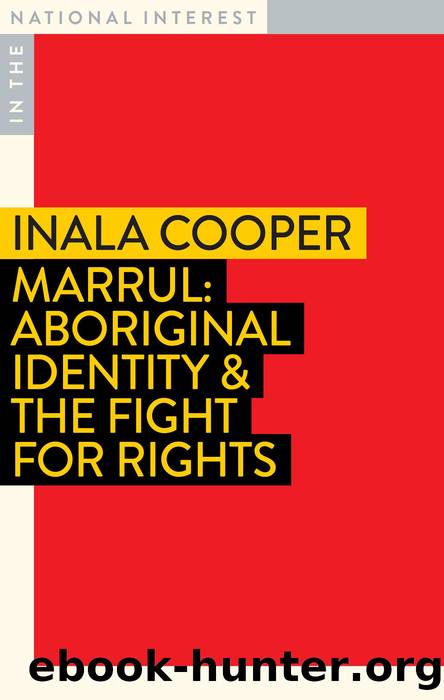
Marrul by Inala Cooper
Author:Inala Cooper
Language: eng
Format: epub
Publisher: Monash University Publishing
Published: 2022-06-21T00:00:00+00:00
Change takes effort and commitment, and that commitment must be real and evident among non-Indigenous leaders and decision-makers. You canât address racism simply by having a RAP and holding a morning tea to say youâre sorry. As Bidjara/Birri Gubba Juru woman Aunty Jackie Huggins has said, itâs about more than just making friends. Reconciliation and justice require truth-telling, reparations, the sharing of wealth and power, and compensation. Thinking back to the sacrament of reconciliation in church, if you have a proactive priest who is invested in their congregation, who gives practical advice and guidance, thereâs a greater chance of good resolutions and outcomes between people. A lazy priest who does not care for their congregationâs wellbeing will just instruct you to say ten Hail Marys and tell you to come back next week. Effort and commitment in all our environments are crucial if we are to make this world a better place now and for future generations.
The sharing of wealth and power is a concept that is strikingly absent among Australiaâs authorities and institutions, and it remains something that requires deep interrogation and change. If institutions are serious about ReconciliationâI still want to hear more of them talk about justiceâand aligning with campaigns such as Racism: It Stops with Me, then they need to be proactive in reviewing their governance, leadership and ways of working. Employment initiatives, for example, must do more than provide entry-level roles for Aboriginal/ Torres Strait Islander people. Look at who is in the boardroom, who makes up the executive, and who occupies other leadership positions, because the lived experiences of those individuals, combined with the history and culture of the organisation, define how things operate. It is not complicated. It does not require a complex framework or strategy. It starts with respect and humility. Respect for the unceded land you operate on, and the traditional ownersâ protocols, customs and lore. Respect for our knowledge and excellence we so generously and graciously share. And having the humility to both see and admit that Aboriginal/Torres Strait Islander people display this knowledge and excellence, and ways of knowing, doing and being, which both differ from those of non-Indigenous people and hold extraordinary value.
The practice of appointing people only on merit needs to be done away with, to a certain extent. When people talk about merit as it relates to Aboriginal/Torres Strait Islander people being qualified for or well suited to a job, then the fairness, equality or objectivity that we are being measured against is one that has been constructed by, and is intended to apply to, White people. Thinking back to the comment made one evening in Port Fairy, that my brother and I were âdifferentâ from other Aboriginal kids, this bias indicates that some people think darker-skinned kids are less than, are a problem, donât fit in. Bias, both conscious and unconscious, plays a huge role in the application of merit to individuals, and it is a means of maintaining a safe place from which White
Download
This site does not store any files on its server. We only index and link to content provided by other sites. Please contact the content providers to delete copyright contents if any and email us, we'll remove relevant links or contents immediately.
| Anthropology | Archaeology |
| Philosophy | Politics & Government |
| Social Sciences | Sociology |
| Women's Studies |
Cecilia; Or, Memoirs of an Heiress — Volume 1 by Fanny Burney(32562)
The Great Music City by Andrea Baker(32022)
Cecilia; Or, Memoirs of an Heiress — Volume 2 by Fanny Burney(31959)
Cecilia; Or, Memoirs of an Heiress — Volume 3 by Fanny Burney(31945)
We're Going to Need More Wine by Gabrielle Union(19052)
All the Missing Girls by Megan Miranda(16047)
Pimp by Iceberg Slim(14520)
For the Love of Europe by Rick Steves(14161)
Bombshells: Glamour Girls of a Lifetime by Sullivan Steve(14081)
Norse Mythology by Gaiman Neil(13376)
Talking to Strangers by Malcolm Gladwell(13376)
Fifty Shades Freed by E L James(13247)
Mindhunter: Inside the FBI's Elite Serial Crime Unit by John E. Douglas & Mark Olshaker(9347)
Crazy Rich Asians by Kevin Kwan(9297)
The Lost Art of Listening by Michael P. Nichols(7508)
Enlightenment Now: The Case for Reason, Science, Humanism, and Progress by Steven Pinker(7316)
The Four Agreements by Don Miguel Ruiz(6770)
Bad Blood by John Carreyrou(6626)
Weapons of Math Destruction by Cathy O'Neil(6284)
